We specialize in office design.
YOU CAN ENTRUST US WITH YOUR RENOVATION PROJECT
We will help you find what's best for you.

Architecture and interior design studio founded
by the architect Bianca Giovene di Girasole based in Milan.
BRAND AND ARCHITECTURE
Designing corporate identity through interior design
Upon entering a company's headquarters, its identity can be perceived before it's even stated. It's not necessarily the logo or corporate colors that define it, but rather the combination of choices that shape the environment: materials, lighting, furnishings, layout, and the relationship between spaces. Architecture contributes not only to building the company's image, but also to the way it is experienced on a daily basis. Designing a workplace therefore means interpreting the organization's identity and translating it into a concrete, recognizable, and coherent space, without reducing it to the simple application of corporate identity.

Space distribution area (Noemi Milani, Milan)

Informal meeting room (B.Braun, Milan)
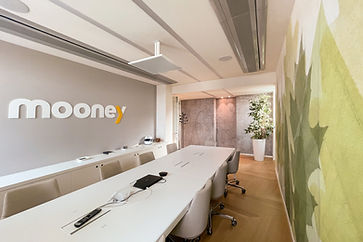
Meeting room (Mooney, Milan)

Classroom (Mooney, Milan)

From brand identity to spatial identity
Every company has an identity shaped by its history, values, people, and organizational culture. The design process begins with understanding these elements and identifying those that can be translated into a spatial dimension. This does not necessarily mean associating a particular value with a specific formal solution, but rather creating an environment in which identity can emerge through the way space is organized and experienced. A company focused on innovation might express this characteristic through more open and adaptable environments, while a more structured organization might require a more clearly defined layout. An organization built around relationships with clients and partners, on the other hand, might place greater emphasis on reception and representative spaces. There is therefore no universal spatial language: the design must identify the one that best reflects the company's culture.
When the brand becomes architecture
Translating identity into space takes place on several levels, which do not necessarily need to be perceived individually. Spatial organization can express how a company operates and encourages interaction; materials, colors, and finishes help create an atmosphere; furnishings and lighting define the character of the environments. Visual communication can also become part of the design through graphics, patterns, typography, and signage systems. The goal is not to incorporate as many references to the brand as possible, but to establish a coherent relationship between these elements and the architecture. A graphic element can become part of a surface, a color accent can guide a circulation route, and a material choice can subtly reflect certain aspects of the company's identity. When these layers are designed together, the brand is no longer something simply applied to the space but becomes part of its architectural language.
The workplace as a communication tool
A company's headquarters is often one of the first physical points of contact between the organization and its stakeholders. Entrances, reception areas, meeting rooms, and shared spaces can serve a representative function and help communicate the company's character. However, the ability of a space to communicate extends beyond its relationship with visitors. The workplace also speaks to the people who use it every day, making values and ways of working tangible that might otherwise remain abstract. Corporate identity therefore operates in two directions: it represents the organization externally while creating an environment in which employees can recognize themselves and feel a sense of belonging. In this sense, architecture becomes an everyday communication tool, rather than simply an image to be presented.
Materials, colors and details
Materials and colors are among the most effective tools for creating a spatial identity, precisely because they influence the perception of an environment without necessarily requiring explicit references to the brand. A particular combination of surfaces, finishes, and textures can define the character of a space and help make it recognizable. The same applies to color, which can be used with varying degrees of intensity. It is not necessary to reproduce the company's color palette in every environment: it may be more effective to introduce it in specific areas, using it to characterize certain spaces, highlight architectural elements, or create continuity between different environments. Even the most subtle details can contribute to the overall perception of a space, provided they are part of a coherent design approach.
Aesthetics and functionality
A workplace can have a strong and recognizable identity while still being ineffective in everyday use. For this reason, identity and functionality must go hand in hand. Design choices must represent the company while also responding to the needs of the people who use the spaces every day. Identity should therefore not impose a particular form on the space, but help define its character without compromising its functionality. A distinctive material must be suitable for its intended use, a visually striking design feature must integrate with the practical requirements of the environment, and a representative space must be both welcoming and functional. The quality of a project lies precisely in the balance between what a space communicates and what it enables people to do.
From brand to experience
Designing corporate identity through the workplace therefore means going beyond the simple application of corporate branding. Architecture, interior design, and visual communication can work together to transform an organization's values and characteristics into a spatial experience. A brand can be recognized through a logo, a color palette, or a graphic system, but it is through space that these elements can acquire a tangible, everyday dimension. When spatial organization, materials, colors, graphics, and details contribute to creating a shared design language, the workplace becomes more than just an operational headquarters. It becomes a place capable of telling the company's story through its architecture, making its culture and values perceptible without necessarily having to state them explicitly.